“And you will hear of wars and rumors of wars. See that you are not troubled; for all these things must come to pass…” — Matthew 24:6
Dear Brothers and Sisters in the Fellowship,
As we observe the sacred Sabbath, our hearts and prayers are turned toward the events unfolding in the Middle East. The news of the massive strikes on Iran (February 28) and the passing of its Supreme Leader has caused the world to tremble. While the “merchants of the earth” fret over oil prices and stock tickers, we look to the Word for our foundation.
1. The Raging of Nations and the Oil of the Earth
The world is currently fixated on the Strait of Hormuz and the sudden spike in oil prices, now climbing past $73 per barrel. In the natural, this represents economic hardship and inflation.
However, we remember that the earth is the Lord’s and the fullness thereof. While the markets react with “distress of nations, with perplexity” (Luke 21:25), we are reminded that our provision does not come from a pipeline or a stock exchange, but from the Hand of the Almighty.
2. The Vacuum of Leadership vs. The King of Kings
There is much talk today about a “power vacuum” in Tehran and the uncertainty of who will lead next. For the believer, this is a sober reminder that “He removes kings and raises up kings” (Daniel 2:21).
The fall of earthly rulers—no matter how powerful—serves as a signpost. As we see the landscape of the Middle East shift overnight, it serves as a call to intensify our study of the prophetic Word, particularly regarding the regions mentioned in Ezekiel and Revelation.
3. A Flight to the True “Safe Haven”
The financial world is currently fleeing to gold and “safe-haven” assets to protect their wealth.
The World’s Strategy: Hoard physical gold and hedge against volatility.
The Sabbath Keeper’s Strategy: “Buy from Me gold refined in the fire, that you may be rich” (Revelation 3:18).
Our peace is not found in the stability of the S&P 500, but in the rest we find in the Sabbath—a weekly reminder that God is the Creator and Sustainer of all.
Fellowship Prayer Points for this Week:
For Peace: Pray for the innocent lives caught in the crossfire of this escalating conflict.
For Wisdom: Pray for our leaders to act with discernment rather than impulse.
For the Harvest: Pray that in this time of fear and “shaking,” many would turn their eyes toward the Prince of Peace.
“The Lord sits as King at the flood; Yes, the Lord sits as King forever. The Lord will give strength to His people; The Lord will bless His people with peace.” — Psalm 29:10-11
Stay grounded in the Word and watchful in the Spirit.
Dating platforms specifically for Sabbath Keepers, or general Christian dating sites with robust filtering options, can be a great place to start relationships for several reasons:
Shared Core Values and Lifestyle:
Fundamental Compatibility: For Sabbath Keepers, observing the Sabbath is a deeply held religious practice and a significant part of their identity and lifestyle. Dating someone who shares this commitment means you’re already aligned on a fundamental aspect of your lives. This reduces potential conflict and misunderstanding down the line, especially concerning weekend activities, family traditions, and spiritual priorities.
Understanding and Respect: A partner who also observes the Sabbath will inherently understand the importance of this day of rest, worship, and spiritual connection. This shared understanding fosters mutual respect and reduces the need for constant explanation or compromise regarding a core religious practice.
Common Goals: When both individuals prioritize their faith and Sabbath observance, they often share similar long-term goals for a relationship, marriage, and family life. This includes raising children in a faith-centered home and participating in a shared spiritual community.
Reduced Dating Pool Uncertainty:
Pre-Vetted Matches: These platforms essentially “pre-vet” matches based on a crucial criterion: shared faith and Sabbath observance. This saves time and effort compared to general dating apps where you might spend weeks or months getting to know someone only to discover a fundamental incompatibility in religious beliefs and practices.
Clear Intentions: Users on these niche sites are typically looking for partners who share their faith and are serious about building a Christ-centered relationship. This can lead to more intentional and purposeful dating.
Community and Support:
Sense of Belonging: Being part of a community of singles who share your faith can be comforting and supportive. You’re connecting with people who understand your worldview and the unique aspects of your lifestyle.
Family and Social Harmony: If your family and social circle are also Sabbath Keepers, finding a partner from the same background can lead to smoother integration into existing family and community networks.
Deeper Connection and Spiritual Growth:
Spiritual Intimacy: Sharing a faith allows for a deeper level of spiritual intimacy. You can pray together, study scripture together, and encourage each other in your spiritual walk.
Mutual Growth: When both partners are committed to their faith, they can support each other in personal and spiritual growth, working towards a common goal of a Christ-centered life.
Practical Considerations:
Time for Rest and Connection: The Sabbath is a day for rest and building relationships. For Sabbath Keepers, this means a dedicated time each week to focus on spiritual connection and quality time with loved ones, which can strengthen a budding relationship.
Online Dating Advantages: Like any online dating platform, these sites offer advantages such as access to a wider pool of potential partners (especially for those in areas with smaller Sabbath-keeping communities), the ability to learn about someone’s values and beliefs through their profile before meeting, and a convenient way to connect with people who might otherwise be difficult to meet.
In essence, a dating platform for Sabbath Keepers creates an environment where shared faith and lifestyle are assumed, allowing individuals to focus on other aspects of compatibility, knowing that a foundational element for a successful relationship is already in place.
This is a powerful and moving account of Perpetua’s martyrdom. Her story is one of incredible faith, defiance, and courage in the face of persecution. The fact that she left behind a firsthand account of her experiences makes her legacy even more profound—she wasn’t just a figure remembered through secondhand stories; her own voice has echoed through history.
It’s remarkable how her suffering not only strengthened the faith of those around her but also even converted her jailer. Her final words—urging unity and perseverance—make her a figure not just of sacrifice but of leadership.
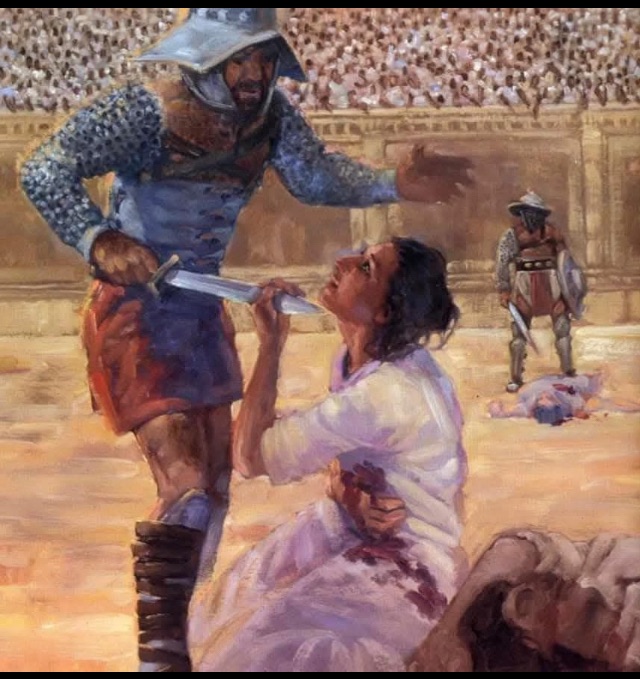
She walked into the Roman arena where the wild beasts awaited her. She trembled not from fear but from joy. Her name was Vibia Perpetua. She was just 22, a young mother singing hymns as the crowd jeered and a lion, leopard and wild cow encircled her.
One of the beasts attacked, hurling her to the ground. She covered an exposed thigh with her bloody robe to preserve her modesty and groped in the dust for her hair pin so she could fix her disheveled hair.
And when a Roman executioner approached Perpetua with a sword, her last words before collapsing were aimed at her Christian companions: “Stand fast in the faith, and love you all one another and do not let our sufferings be a stumbling block to you.”
History remembers Perpetua because she kept a diary during her imprisonment entitled “The Passion of Perpetua and Felicity” (Felicity was a pregnant slave girl arrested with Perpetua). Her diary is one of the rare and oldest-surviving documents written by a Christian woman. The emotion in the diary is almost unbearable. Perpetua describes the pain of leaving her infant son, who she was still nursing. She describes a prison visit from her weeping father, who kissed her hands while pleading with her to renounce her faith.
A narrator picks up the story in the diary after Perpetua was sent to her death. He wrote in the diary that Perpetua’s faith was so inspiring it caused the prison’s warden to convert. The narrator also describes Perpetua’s death. While she was imprisoned, Perpetua says God gave her visions to reassure her. After one, she wrote: “I understood that I should fight, not with beasts but against the devil.”
Numbers 5:11-31 describes a ritual for a woman suspected of adultery. In this ritual, the priest would mix holy water with dust from the tabernacle floor and the woman would drink it. This water is sometimes referred to as “bitter water” or “water of bitterness” in various translations. The text does not explicitly mention whether the woman is pregnant, but some interpretations suggest that the ritual could result in a miscarriage if the woman is guilty. However, other interpretations focus on the swelling of the abdomen and the wasting away of the thigh as signs of divine judgment, rather than a direct reference to abortion. Numbers 5:11-31 The Test for an Unfaithful Wife 11 Then the Lord said to Moses, 12 “Speak to the Israelites and say to them: ‘If a man’s wife goes astray and is unfaithful to him 13 so that another man has sexual relations with her, and this is hidden from her husband and her impurity is undetected (since there is no witness against her and she has not been caught in the act), 14 and if feelings of jealousy come over her husband and he suspects his wife and she is impure—or if he is jealous and suspects her even though she is not impure— 15 then he is to take his wife to the priest. He must also take an offering of a tenth of an ephah[a] of barley flour on her behalf. He must not pour olive oil on it or put incense on it, because it is a grain offering for jealousy, a reminder-offering to draw attention to wrongdoing.
16 “‘The priest shall bring her and have her stand before the Lord. 17 Then he shall take some holy water in a clay jar and put some dust from the tabernacle floor into the water. 18 After the priest has had the woman stand before the Lord, he shall loosen her hair and place in her hands the reminder-offering, the grain offering for jealousy, while he himself holds the bitter water that brings a curse. 19 Then the priest shall put the woman under oath and say to her, “If no other man has had sexual relations with you and you have not gone astray and become impure while married to your husband, may this bitter water that brings a curse not harm you. 20 But if you have gone astray while married to your husband and you have made yourself impure by having sexual relations with a man other than your husband”— 21 here the priest is to put the woman under this curse—“may the Lord cause you to become a curse[b] among your people when he makes your womb miscarry and your abdomen swell. 22 May this water that brings a curse enter your body so that your abdomen swells or your womb miscarries.”
“‘Then the woman is to say, “Amen. So be it.”
23 “‘The priest is to write these curses on a scroll and then wash them off into the bitter water. 24 He shall make the woman drink the bitter water that brings a curse, and this water that brings a curse and causes bitter suffering will enter her. 25 The priest is to take from her hands the grain offering for jealousy, wave it before the Lord and bring it to the altar. 26 The priest is then to take a handful of the grain offering as a memorial[c] offering and burn it on the altar; after that, he is to have the woman drink the water. 27 If she has made herself impure and been unfaithful to her husband, this will be the result: When she is made to drink the water that brings a curse and causes bitter suffering, it will enter her, her abdomen will swell and her womb will miscarry, and she will become a curse. 28 If, however, the woman has not made herself impure, but is clean, she will be cleared of guilt and will be able to have children.
29 “‘This, then, is the law of jealousy when a woman goes astray and makes herself impure while married to her husband, 30 or when feelings of jealousy come over a man because he suspects his wife. The priest is to have her stand before the Lord and is to apply this entire law to her. 31 The husband will be innocent of any wrongdoing, but the woman will bear the consequences of her sin.’”
National Library of Medicine • An abortion is a procedure to end a pregnancy. It can be done two different ways: Medication abortion, which uses medicines to end the pregnancy. It is sometimes called a “medical abortion” or “abortion with pills.” Procedural abortion, a procedure to remove the pregnancy from the uterus. It is sometimes called a “surgical abortion.”
In this video, we dive into the biblical perspective on abortion, addressing one of today’s most debated topics. Learn what the Bible teaches about the sanctity of life, God’s role in creation, and His thoughts on the value of unborn children. We’ll explore 7 key facts, including how God forms life in the womb and why every life is precious in His sight. Whether you are pro-life or seeking answers, this video provides a thorough, Bible-based approach to understanding abortion from a Christian worldview. 📖 Bible Verses Covered: Psalm 139:13-14, Jeremiah 1:4-5, Ezekiel 16:20-21, John 14:6, Deuteronomy 24:16, and more. 🙏 Remember: Choose life, and know that Jesus loves you. #BibleStudy#ProLife#AbortionDebate#ChristianPerspective#FaithAndLife#BiblicalTruth
#abortion: A general hashtag related to abortion
#prochoice: A hashtag that supports abortion rights
#prolife: A hashtag that opposes abortion rights
#antichoice: A hashtag that opposes abortion rights
#antilife: A hashtag that opposes abortion rights
#BansOffOurBodies: A hashtag that supports abortion rights and opposes abortion bans
#WhateverTheReason: A hashtag that supports abortion rights and opposes abortion bans
#abortionrights: A hashtag that supports abortion rights
#ShoutYourAbortion: A social media campaign that encourages women to speak out about their abortion decisions
For Sabbath-keepers, dating can involve finding someone who shares their beliefs and values. This often means finding someone who also observes the Sabbath, which typically falls on Saturday.
Sabbath-keepers may use Christian dating sites or apps to find a partner. Some examples of Christian dating sites and apps include:
Christian Mingle: A dating site for Christians
Christian Cupid: A dating site for Christians
Christian Connection: A dating site for Christians
Holy: A Christian dating app for meeting people who love Jesus
Explanation
Sabbath-keepers believe that Christians should observe the Bible Sabbath on Saturday. Seventh-day Adventists are a Christian denomination that observe the Sabbath on Saturday. They believe that the Sabbath is a day of rest and worship.
Here are some potential approaches:
Community Involvement:
Sabbath-keeping churches or fellowships: These provide opportunities to meet others who share your faith and observe the Sabbath.
Sabbath-keeping events and activities: Some communities organize Sabbath-focused events, retreats, or social gatherings.http://SabbathKeepersDating.com
Online Dating:
Specific platforms: Some online dating platforms cater to specific religious communities, including Sabbath-keepers.
Clear profiles: When using general dating platforms, clearly state your faith and Sabbath observance in your profile to attract compatible matches.
Friends and Family:
Introductions: Ask trusted friends and family members if they know any single Sabbath-keepers who might be a good match.
Important Considerations:
Shared Values: While Sabbath observance is important, it’s crucial to find someone who shares your broader values and life goals.
Communication: Open and honest communication about your faith and how you observe the Sabbath is essential.
Respect and Understanding: Be respectful of your partner’s beliefs and practices, even if they differ slightly from your own.
Disclaimer: This information is for general knowledge and guidance only.
Note: The term “Sabbath-keeper” can encompass individuals from various faith traditions, including Seventh-day Adventists, Jews, and others.



 sabbathkeepersfellowship.com